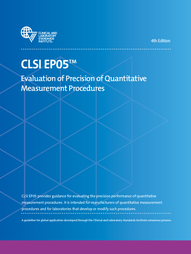
CLSI EP05 Plus
Evaluation of Precision of Quantitative Measurement Procedures
CLSI EP05 provides guidance for evaluating the precision performance of quantitative measurement procedures. It is intended for manufacturers of quantitative measurement procedures and for laboratories that develop or modify such procedures.
CLSI EP05 comes with EP05 Quick Guide, a guide designed to help users evaluate the precision of quantitative measurement procedures of IVD devices. This product cannot be purchased separately.
{{FormatPrice(currentPrice)}}
Free
{{FormatPrice(nonMemberPrice)}} List PriceCLSI EP05—Evaluation of Precision of Quantitative Measurement Procedures provides guidance for evaluating the precision of in vitro diagnostic quantitative measurement experimental designs and includes recommendations for establishing precision performance. Included are guidelines for durations of testing, experimental designs, materials, data analysis, data summary, and interpretation techniques adaptable for a wide spectrum of measurands and system complexity. These guidelines are intended for manufacturers or developers of medical laboratory measurement procedures and for users to determine their own system and measurand performance characteristics. A balance is created in CLSI EP05 between complexity of design and analysis and simplicity of the evaluation procedure.
1.1 Scope
CLSI EP05 provides guidance for studies intended to establish the within-site precision performance characteristics of quantitative measurement procedures used in medical laboratories and also for studies addressing site-to-site variability. Multiple experimental protocols are described, along with considerations on how to select and optimize the protocol(s) best suited for a specific measurement procedure (or “assay”) and its intended use.
1.1.1 Intended Users
Intended users of CLSI EP05 are:
- Developers of a new measurement procedure establishing precision characteristics, such as manufacturers that want to distribute the product to multiple laboratories or medical laboratories developing the measurement procedure for their own use
- End users who modify an existing assay and therefore need to reassess its precision performance
- Users who want to understand how precision performance estimates are established and/or want to perform precision assessments of their own
- Manufacturers in need of advanced methods (see Appendix C) for obtaining deeper insights into the precision characteristics of a quantitative measurement procedure during assay development, optimization, and routine manufacture
It is assumed that readers of CLSI EP05 have some familiarity with statistical data analysis, including basic analysis of variance (ANOVA), or access to statistical support resources. Subchapter 1.5 provides a brief introduction to several of the basic concepts involved, while CLSI EP15 includes a detailed discussion of 1-way ANOVA.
1.1.2 Limitations on Use
Users verifying a manufacturer’s claims for the precision of a quantitative clinical measurement procedure should follow the guidance in CLSI EP15.
The protocols in CLSI EP05 may not be applicable to some quantitative measurement procedures for which appropriate test materials do not exist. In particular, the standardized single-site and multisite procedures are not directly applicable to measurement procedures involving samples with inadequate stability (eg, red blood cell count or blood gas determinations) and/or inadequate volume (eg, fluorescence in situ hybridization or immunohistochemistry determinations on tissue samples).
The analytical process is assumed to be stable with no degradation of samples or reagents taking place during the period of data collection. This leads to an assumption that variation of measurement results is random; moreover, that variation coming from each source being considered is independently and normally distributed. Evaluation of reagent degradation is covered in CLSI EP25. Handling, transport, processing, and storage of blood specimens is described in CLSI PRE04.
CLSI EP05 provides guidelines for use with quantitative measurement procedures and instruments, including those on which qualitative determinations are based. Evaluation of precision performance for fully qualitative binary measurement procedures or instruments, however, is beyond the scope of CLSI EP05. For this type of evaluation, consult CLSI EP12 and literature.
This document is available in electronic format only.
EP05Ed3
EP05Ed3E
CLSI EP05—Evaluation of Precision of Quantitative Measurement Procedures provides guidance for evaluating the precision of in vitro diagnostic quantitative measurement experimental designs and includes recommendations for establishing precision performance. Included are guidelines for durations of testing, experimental designs, materials, data analysis, data summary, and interpretation techniques adaptable for a wide spectrum of measurands and system complexity. These guidelines are intended for manufacturers or developers of medical laboratory measurement procedures and for users to determine their own system and measurand performance characteristics. A balance is created in CLSI EP05 between complexity of design and analysis and simplicity of the evaluation procedure.
1.1 Scope
CLSI EP05 provides guidance for studies intended to establish the within-site precision performance characteristics of quantitative measurement procedures used in medical laboratories and also for studies addressing site-to-site variability. Multiple experimental protocols are described, along with considerations on how to select and optimize the protocol(s) best suited for a specific measurement procedure (or “assay”) and its intended use.
1.1.1 Intended Users
Intended users of CLSI EP05 are:
- Developers of a new measurement procedure establishing precision characteristics, such as manufacturers that want to distribute the product to multiple laboratories or medical laboratories developing the measurement procedure for their own use
- End users who modify an existing assay and therefore need to reassess its precision performance
- Users who want to understand how precision performance estimates are established and/or want to perform precision assessments of their own
- Manufacturers in need of advanced methods (see Appendix C) for obtaining deeper insights into the precision characteristics of a quantitative measurement procedure during assay development, optimization, and routine manufacture
It is assumed that readers of CLSI EP05 have some familiarity with statistical data analysis, including basic analysis of variance (ANOVA), or access to statistical support resources. Subchapter 1.5 provides a brief introduction to several of the basic concepts involved, while CLSI EP15 includes a detailed discussion of 1-way ANOVA.
1.1.2 Limitations on Use
Users verifying a manufacturer’s claims for the precision of a quantitative clinical measurement procedure should follow the guidance in CLSI EP15.
The protocols in CLSI EP05 may not be applicable to some quantitative measurement procedures for which appropriate test materials do not exist. In particular, the standardized single-site and multisite procedures are not directly applicable to measurement procedures involving samples with inadequate stability (eg, red blood cell count or blood gas determinations) and/or inadequate volume (eg, fluorescence in situ hybridization or immunohistochemistry determinations on tissue samples).
The analytical process is assumed to be stable with no degradation of samples or reagents taking place during the period of data collection. This leads to an assumption that variation of measurement results is random; moreover, that variation coming from each source being considered is independently and normally distributed. Evaluation of reagent degradation is covered in CLSI EP25. Handling, transport, processing, and storage of blood specimens is described in CLSI PRE04.
CLSI EP05 provides guidelines for use with quantitative measurement procedures and instruments, including those on which qualitative determinations are based. Evaluation of precision performance for fully qualitative binary measurement procedures or instruments, however, is beyond the scope of CLSI EP05. For this type of evaluation, consult CLSI EP12 and literature.
This document is available in electronic format only.
EP05Ed3
EP05Ed3E