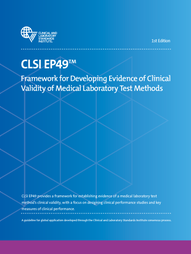
CLSI EP49
Framework for Developing Evidence of Clinical Validity of Medical Laboratory Test Methods
CLSI EP49 provides a practical, holistic, standards‑based framework to help manufacturers and laboratories that develop their own tests clearly establish and communicate the clinical validity of medical laboratory test methods.
This document supports informed decision‑making by aligning clinical validity with the test’s intended use and role in patient care as well as its analytical performance. The result is a framework that supports sustained confidence in performance across the test lifecycle and it applies to qualitative, semi-quantitative, and quantitative assays.
Clinical validity is increasingly central to regulatory review, clinical adoption, and post‑market confidence. CLSI EP49 helps organizations:
- Establish a clear, defensible rationale for a test’s clinical validity
- Design and document clinical performance studies that support real‑world use
- Align clinical and analytical validation
- Anticipate questions from regulators, reviewers, and clinical stakeholders
- Support ongoing confidence in test performance after launch
CLSI EP49 is intended for:
- IVD manufacturers developing or updating test methods
- Clinical laboratories establishing or validating LDTs
- Teams responsible for clinical performance studies and evidence generation
- Organizations preparing for regulatory review or internal governance
- Professionals seeking alignment with internationally recognized best practices
Need multiple copies? We offer discounted pricing for volume purchases. Contact CustomerService@clsi.org or 610.688.0100 for assistance.
{{FormatPrice(currentPrice)}}
Free
{{FormatPrice(nonMemberPrice)}} List PriceCLSI EP49, Framework for Developing Evidence of Clinical Validity of Medical Laboratory Test Methods provides test developers (both manufacturers and laboratories that create laboratory-developed tests) with a framework for establishing evidence of clinical validity for a medical laboratory test method. Clinical validation is defined and discussed in the context of clinical utility and analytical validation during the establishment of a test method. CLSI EP49 focuses on evaluating clinical validity through a clinical performance study, comparing a candidate test method with a comparator for assessing a target condition based on the test method’s intended use. Purposes and categories of tests are described along with measures of a test method’s clinical performance. Considerations are outlined for components of a study protocol and clinical performance study report, as well as for monitoring clinical validity postlaunch.
Additional topics discussed in CLSI EP49 include obtaining samples for clinical performance studies, use of real-world data, potential biases in subject selection, and ethical considerations.
This document is available in electronic format only.
CLSI EP49, Framework for Developing Evidence of Clinical Validity of Medical Laboratory Test Methods provides test developers (both manufacturers and laboratories that create laboratory-developed tests) with a framework for establishing evidence of clinical validity for a medical laboratory test method. Clinical validation is defined and discussed in the context of clinical utility and analytical validation during the establishment of a test method. CLSI EP49 focuses on evaluating clinical validity through a clinical performance study, comparing a candidate test method with a comparator for assessing a target condition based on the test method’s intended use. Purposes and categories of tests are described along with measures of a test method’s clinical performance. Considerations are outlined for components of a study protocol and clinical performance study report, as well as for monitoring clinical validity postlaunch.
Additional topics discussed in CLSI EP49 include obtaining samples for clinical performance studies, use of real-world data, potential biases in subject selection, and ethical considerations.
This document is available in electronic format only.