Conflict of Interest Policy
Last updated: 09 September 2026
1. Purpose
The purpose of this policy is to protect the integrity, independence, credibility, and mission of the Clinical and Laboratory Standards Institute (CLSI) by establishing a consistent organization-wide framework to identify, disclose, evaluate, document, manage, and resolve actual, potential, and perceived conflicts of interest involving Board members, officers, and volunteers.
This policy recognizes that CLSI benefits from the expertise of individuals from health care professions, government, industry, academia, professional associations, and other stakeholder groups. The existence of an interest does not automatically disqualify an individual from service. Transparency, balanced participation, impartial decision-making, and documented management of conflicts are essential to preserve trust in CLSI’s governance and standards-development activities.
2. Scope
This policy applies to all individuals serving CLSI in a volunteer or governance capacity, including:
- Members of the Board of Directors and officers
- Members of the Executive Committee and any committee or task force exercising authority delegated by the Board
- Members and leaders of the Consensus Council, expert panels, document development committees, document review working groups, subcommittees, working groups, ad hoc working groups, appeals panels, and other standards-development bodies
- Members and leaders of advisory councils, award or nominating committees, program committees, special initiatives, task forces, and other volunteer bodies
- Advisors, contributors, reviewers, subject matter experts, faculty, and other individuals acting on behalf of CLSI
- Any person authorized to make, influence, recommend, or oversee a decision for CLSI
Employees and contractors are governed by applicable CLSI employee, contractor, program-specific, and firewall policies. When an individual serves in more than one capacity, the most protective applicable requirement controls. Program-specific policies may impose additional restrictions and are not replaced by this policy.
3. Definitions
abstention ─ not casting a vote; NOTE: Abstention alone is not necessarily sufficient when recusal is required.
actual conflict of interest ─ a situation in which a covered person’s personal, financial, professional, organizational, fiduciary, or other interest directly competes with, could improperly influence, or is inconsistent with the individual’s duties to CLSI in a specific matter.
covered person ─ any Board member, officer, volunteer leader, committee participant, advisor, contributor, reviewer, expert, or other volunteer within the scope of this policy.
financial interest ─ a direct or indirect ownership, investment, compensation, consulting, honoraria, grant, royalty, intellectual property, gift, travel support, debt, prospective employment, or other economic interest that could be affected by a CLSI matter; NOTE: Interests held through broadly diversified funds over which the covered person exercises no investment control generally need not be disclosed unless required by a disclosure form or specific activity.
interested person ─ a covered person who has disclosed, or is reasonably believed to have, an interest relevant to a matter under consideration.
perceived conflict of interest ─ a circumstance in which a reasonable, informed outside observer could question the Covered Person’s impartiality, even if no improper influence actually occurs.
potential conflict of interest ─ a circumstance that could reasonably develop into an actual conflict or create a meaningful risk of divided loyalty or impaired objectivity.
professional or organizational interest ─ employment, leadership, fiduciary service, consulting, advisory work, sponsorship, research support, advocacy, expert testimony, or another relationship with an entity that may be affected by a CLSI decision or publication.
recusal ─ complete nonparticipation in specified discussion, access, deliberation, recommendation, influence, and voting concerning a matter.
related person ─ a spouse or domestic partner; parent, child, sibling, step-relative, in-law, or other close relative; household member; or another person whose relationship with the covered person could reasonably affect, or appear to affect, the covered person’s judgment.
standards-development activity ─ any activity involving the proposal, authorization, development, revision, review, balloting, approval, reaffirmation, withdrawal, interpretation, publication, derivative use, or appeal of a CLSI standard, guideline, supplement, or related product.
volunteer leadership role ─ any volunteer position with authority to set agendas, appoint or remove participants, facilitate deliberations, assign work, determine voting eligibility, resolve procedural matters, recommend outcomes, or speak on behalf of a CLSI body.
4. Policy Statement
Covered persons shall act in the best interests of CLSI and its charitable and standards-development mission; exercise independent judgment; avoid using CLSI service, information, property, relationships, or opportunities for improper personal or third-party benefit; disclose interests fully and promptly; and comply with all required mitigation, recusal, abstention, confidentiality, and documentation measures.
CLSI will evaluate conflicts fairly and consistently. A disclosed interest may be manageable, may require limited participation, or may require recusal or disqualification. Nondisclosure, incomplete disclosure, failure to follow a management plan, or retaliation against a good-faith reporter is prohibited.
5. Interests and Circumstances Requiring Disclosure
Covered persons shall disclose any interest that could reasonably be relevant to their CLSI responsibilities. When uncertain, the individual should disclose. Examples include, but are not limited to:
- Current, recent, or prospective employment, consulting, advisory, fiduciary, or leadership relationships
- Ownership or investment interests, options, partnership interests, compensation arrangements, royalties, patents, patent applications, licensing interests, or other intellectual property interests
- Research grants, sponsored studies, institutional funding, gifts, honoraria, travel support, equipment, services, or in-kind contributions greater than $5000 USD
- Relationships with organizations that may benefit from, be disadvantaged by, implement, sell products or services related to, or be regulated or evaluated using a CLSI standard, guideline, program, procurement, partnership, or decision
- Participation in litigation, expert testimony, advocacy, regulatory submissions, accreditation decisions, certification activities, or public positions related to the matter under consideration
- A related person’s relevant interest
- Gifts, entertainment, favors, or business courtesies that could reasonably be viewed as intended to influence a CLSI decision
- Use of nonpublic CLSI information or opportunities for personal, employer, client, or third-party advantage
- Any personal relationship, strong commitment, or other circumstance that could reasonably call impartiality into question.
Disclosure does not, by itself, establish that a conflict exists or imply wrongdoing. It permits CLSI to make and document an informed determination.
6. Disclosure Requirements
6.1 Disclosure Requirements
Each covered person shall complete CLSI’s applicable Acceptance of Policies and Disclosure of Interests Form before beginning service, upon election or appointment to a new governance or volunteer leadership role, upon reappointment, and at the periodic interval established by CLSI. Board members, officers, and volunteer leaders shall complete or reaffirm disclosures annually.
6.2 Continuing Duty to Update
A covered person shall update the disclosure promptly, and no later than 30 calendar days after becoming aware of a material change. A new or changed interest relevant to an active matter shall be disclosed before further participation in that matter.
6.3 Meeting-Specific Disclosure
At the beginning of each Board, Consensus Council, expert panel, subcommittee, document development committee, or working-group meeting, the presiding leader or staff member shall invite disclosure of new or agenda-specific interests. The invitation and any disclosures, determinations, recusals, and abstentions shall be documented in the meeting record.
6.4 Completeness and Good Faith
Disclosures shall be truthful, complete to the best of the individual’s knowledge, and sufficiently specific to permit evaluation. If privacy or confidentiality concerns limit the information that can be shared with the full body, the covered person shall provide the necessary details confidentially to the designated reviewer.
7. General Review and Management Process
Disclosure. The interested person discloses the relevant interest and all material facts to the presiding leader, staff member, Governance Officer, or other designated reviewer.
Preliminary review. The designated reviewer determines whether the matter may proceed without restriction, requires safeguards, or warrants referral for an independent determination.
Opportunity to provide information. The interested person may provide factual information and answer questions but shall not control the conflict determination.
Deliberation without the interested person. When a conflict determination or management action is required, the Interested Person shall leave the discussion unless requested solely to provide information.
Determination. Disinterested decision-makers determine, by majority vote when appropriate, whether an actual, potential, or perceived conflict exists and what management action is required.
Management. The body considers reasonable alternatives and selects safeguards that protect CLSI and the integrity of the decision.
Documentation and monitoring. The determination, rationale, action, vote, recusal, and monitoring responsibility are recorded. Management measures remain in effect until modified or closed in writing.
8. Available Management Measures
Depending on the nature and severity of the conflict, CLSI may impose one or more of the following measures:
- Disclosure to the body or affected stakeholders
- Participation limited to providing factual or technical information
- Abstention from voting
- Recusal from discussion, deliberation, recommendations, document access, voting, or influence
- Removal from agenda-setting, appointment, review, approval, appeal, or oversight responsibility
- Reassignment of leadership, drafting, reviewer, liaison, or decision-making duties
- Use of an independent or balanced review panel
- Restriction of access to confidential or nonpublic information
- Written conflict-management plan, including duration, monitoring, and reporting requirements
- Divestiture or termination of the conflicting relationship, when voluntarily offered and appropriate
- Temporary suspension or permanent removal from the relevant activity or volunteer role
- Disqualification from service when the conflict cannot be adequately managed
Management shall be proportionate to the risk and sufficiently protective of both actual impartiality and the reasonable appearance of impartiality. The need for an individual’s expertise does not, by itself, justify participation in a conflicted decision.
9. Standards Development Specific Requirements
9.1 Openness, Balance, and Lack of Dominance
CLSI standards development activities shall be conducted through fair and open processes that seek appropriate expertise, representation of relevant constituencies, balance where required, and protection against dominance by any individual, organization, or interest category. Disclosure and conflict management shall not be used to suppress a legitimate viewpoint or to manipulate constituency balance.
9.2 Vested Interests and Technical Participation
A volunteer may possess relevant industry, government, health care, academic, or professional interests and still contribute valuable expertise. A vested interest that is transparent and appropriately classified does not automatically constitute a disqualifying conflict. Participation becomes restricted when the interest creates an unacceptable risk that the volunteer’s judgment, leadership, access, or vote will not be impartial, or when a reasonable observer would question the integrity of the process.
9.3 Project- and Topic-Specific Screening
Standards development disclosures shall be evaluated in relation to the specific project, product, technology, method, analyte, therapeutic area, organization, intellectual property, or decision under consideration. A volunteer cleared for one project or topic may require different management for another.
9.4 Drafting, Data, and Intellectual Property
A volunteer shall disclose authorship, sponsorship, proprietary data, patents, licensing interests, royalties, product-specific research, or other interests that could benefit from inclusion, exclusion, wording, thresholds, methods, claims, or recommendations in a CLSI document. A volunteer shall not use the process to promote a proprietary product, suppress relevant evidence, secure competitive advantage, or obtain improper access to another party’s confidential information.
9.5 Balloting and Voting
A voting participant shall vote based on the evidence, the approved scope, the integrity of the consensus process, and CLSI’s mission. A conflicted voter may be required to abstain or to recuse. Any recusal shall be reflected in quorum and voting records as required by the applicable standards development processes or procedures. An abstention shall not be used to conceal an undisclosed conflict.
9.6 Appeals and Procedural Challenges
No person with a material interest in the outcome, or who participated substantially in the decision under appeal, may serve as an impartial decision-maker on that appeal. Technical knowledge may be provided to an appeals body without conferring decision-making authority on the interested person.
9.7 Standards Development Leadership
Chairholders, vice-chairholders, secretaries, Consensus Council leaders, expert panel leaders, and other standards development leaders have heightened duties to model disclosure, invite agenda-specific disclosures, prevent dominance, apply participation rules consistently, avoid steering deliberations toward a personal or organizational outcome, and promptly elevate unresolved concerns to the designated CLSI reviewer.
10. Governance and Volunteer Leadership-Specific Requirements
10.1 Fiduciary and Mission-Centered Duty
Board members, officers, and governance volunteers shall exercise their duties in the best interests of CLSI and not as representatives directed by an employer, client, sponsor, constituency, donor, or other outside party. Background and perspective may inform deliberation, but loyalty in the governance role is owed to CLSI.
10.2 Transactions and Arrangements
An interested person shall not participate in the approval of a transaction, contract, compensation arrangement, grant, partnership, sponsorship, procurement, licensing arrangement, or other decision that could confer a material benefit on the individual, a related person, or an affiliated entity. The disinterested decision-makers shall determine that the arrangement is fair, reasonable, in CLSI’s best interests, and no more favorable than an appropriate alternative, using comparability information when warranted.
10.3 Nominations, Appointments, and Awards
A volunteer leader shall disclose close personal, supervisory, financial, or professional relationships with a nominee, candidate, applicant, or competing organization. The leader may be required to recuse from candidate screening, ranking, appointment, removal, compensation, recognition, or award decisions.
10.4 Oversight of Programs and Committees
A governance or volunteer leader shall not use oversight authority to influence a technical, commercial, regulatory, personnel, publication, or program decision for personal or affiliated-organization benefit. Oversight shall remain within the authority assigned by the CLSI Bylaws, Board-adopted policies, charters, and delegated authorities.
10.5 Confidential and Nonpublic Information
Board members and volunteer leaders shall use confidential and nonpublic information only for authorized CLSI purposes. They shall not seek restricted information outside their role, disclose it to an employer or third party, use it in external decision-making, or trade or transact based on it.
10.6 Leadership Response to Disclosures
A presiding leader who has a conflict shall transfer conflict-review and meeting-control responsibilities for that matter to an unconflicted alternate. A leader shall not unilaterally resolve their own conflict. When the leader is uncertain, the matter shall be elevated to the designated CLSI reviewer.
11. Decision Authority and Escalation
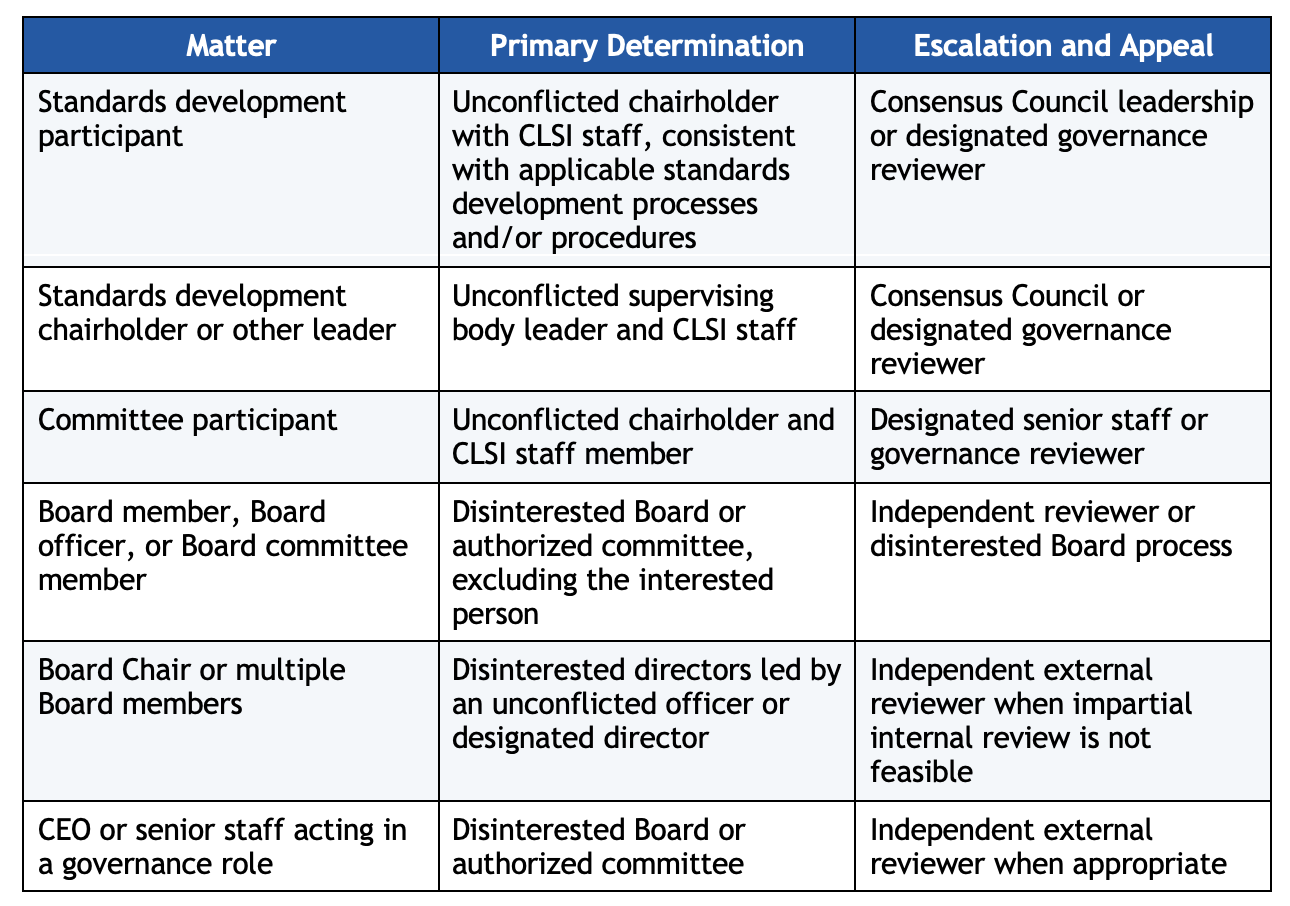
If the applicable decision-maker is conflicted, unavailable, or cannot reasonably be impartial, the matter shall be reassigned to an unconflicted person or independent reviewer. Appeals are limited to alleged procedural error, material new information, or an unreasonable management determination and do not stay a recusal unless expressly authorized.
12. Meeting and Records Requirements
Meeting minutes or comparable records shall document, as applicable:
- Name of the person who disclosed or was identified as having a possible conflict
- The general nature of the interest, while avoiding unnecessary confidential personal details
- Whether the person was present for fact-finding, deliberation, and voting
- Determination and the persons participating in it
- Alternatives considered for a transaction or management action
- Management measure, recusal, abstention, or disqualification imposed
- Vote and quorum treatment, when applicable
- Any follow-up, monitoring, expiration, or reassessment requirement
Disclosure forms, determinations, management plans, attestations, and related records shall be retained in accordance with CLSI’s records-retention requirements, with access limited to those who have a legitimate business need. Information may be shared when necessary to administer the policy, comply with law or accreditation requirements, protect due process, or demonstrate integrity of the applicable process.
13. Prohibited Conduct
- Failing to disclose a known relevant interest
- Providing false, misleading, or materially incomplete disclosure information
- Participating after recusal or attempting to influence others indirectly
- Using CLSI’s name, position, property, confidential information, relationships, or opportunities for improper gain
- Offering, soliciting, or accepting a bribe, kickback, improper inducement, or business courtesy intended to influence a CLSI matter
- Retaliating against a person who reports a concern or participates in a review in good faith
- Using conflict allegations strategically to exclude a legitimate viewpoint, competitor, constituency, or participant
- Interfering with an investigation, concealing records, or violating a management plan.
14. Reporting Concerns and Non-Retaliation
A covered person who becomes aware of a possible undisclosed conflict or violation shall report it promptly to the responsible staff member, committee chairholder, Governance Officer, Chief Executive Officer, Board Chairholder, Quality Officer, or another channel identified in CLSI’s whistleblower or ethics policies. Reports involving any of those individuals shall be directed to an unconflicted alternative.
CLSI prohibits retaliation against anyone who raises a concern, seeks guidance, makes a good-faith report, or participates in a review. Knowingly false or malicious allegations are not protected.
15. Violations and Corrective Action
Possible violations shall be reviewed promptly, fairly, and as confidentially as practicable. The covered person will be informed of the concern and provided a reasonable opportunity to respond, except when immediate protective action is necessary. Corrective action may include education, supplemental disclosure, a management plan, reconsideration of a decision, correction of a record or publication, restriction of duties, removal from leadership, suspension, termination of volunteer service, referral under another CLSI policy, or other appropriate action.
Material non-disclosure or a violation that may have compromised a governance or standards-development outcome shall trigger an assessment of whether the affected decision, ballot, appointment, transaction, document, or process should be reviewed, repeated, corrected, disclosed, or otherwise remediated.
16. Training and Annual Attestation
Board members, officers, and volunteer leaders shall receive conflict-of-interest orientation upon appointment and periodic refresher training. CLSI may require additional training for standards development participants or other volunteers based on role and risk. Required covered persons shall attest that they have read, understand, and will comply with this policy and applicable management measures.
17. Policy Administration, Review, and Exceptions
The designated policy owner is responsible for implementation guidance, disclosure administration, training coordination, record controls, and periodic review. This policy shall be reviewed at least every two years and sooner when changes in law, accreditation requirements, organizational structure, or CLSI activities warrant revision.
No exception may permit undisclosed participation, self-approval of a conflict, improper private benefit, circumvention of standards-development due process, or conduct prohibited by law. Any exception must be written, narrowly tailored, time-limited, supported by documented reasons, approved by an unconflicted authority, and include safeguards sufficient to protect CLSI and the integrity of the activity.
18. Relationship to Other Requirements
This policy supplements:
- CLSI’s Bylaws
- Standards Development Policies and Processes
- Volunteer Code of Ethics and Business Conduct Policy
- Acceptance of CLSI Policies and Disclosure of Interests Form
- Volunteer Whistleblower Policy
- Firewall Policy
- Documents and Records Retention Policy
- Any program-specific conflict-of-interest, confidentiality, antitrust, intellectual property, or conduct requirements
If requirements differ, CLSI shall apply the provision that provides the greater protection unless legal counsel or the Board determines otherwise in writing.