You'll receive the latest updates on new standards, guidelines, and educational resources, as well as expert insights to help enhance your laboratory's performance and compliance.
May 26, 2026
Purpose-Driven Content for EP Documents: A Strategic Update
CLSI Evaluation Protocol (EP) documents are foundational to medical laboratory medicine and as such are among the most frequently referenced CLSI documents by laboratories, manufacturers, regulators, and other standards developers.
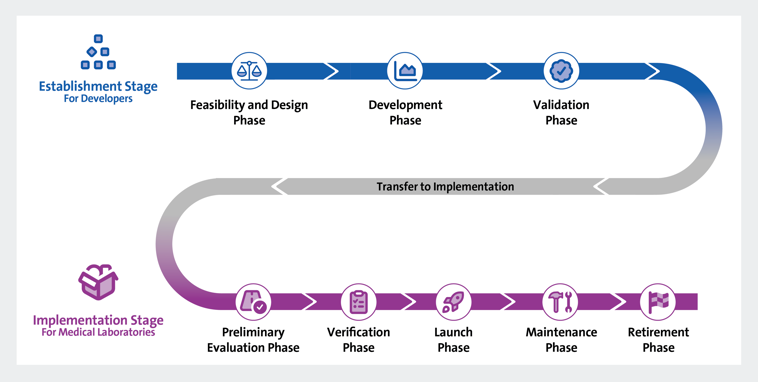
The EP guidance documents are relied upon across the Test Life Phases Model (see image below), from the establishment phases of development and validation to the implementation phases of verification and ongoing maintenance. EP documents are integral to maintaining the robustness, reliability, comparability, and clinical significance of laboratory test results, while ensuring compliance with regulatory standards.
The Expert Panel on Method Evaluation is leading a strategic initiative to restructure EP documents, using a modular, purpose‑driven framework. This approach maintains scientific rigor while improving usability and navigation. This initiative marks a significant evolution in how EP guidance is organized and delivered to better support its consistent and effective application in practice.

CLSI Evaluation Protocol (EP) documents are foundational to medical laboratory medicine and as such are among the most frequently referenced CLSI documents by laboratories, manufacturers, regulators, and other standards developers.
The EP guidance documents are relied upon across the Test Life Phases Model (see image below), from the establishment phases of development and validation to the implementation phases of verification and ongoing maintenance. EP documents are integral to maintaining the robustness, reliability, comparability, and clinical significance of laboratory test results, while ensuring compliance with regulatory standards.
The Expert Panel on Method Evaluation is leading a strategic initiative to restructure EP documents, using a modular, purpose‑driven framework. This approach maintains scientific rigor while improving usability and navigation. This initiative marks a significant evolution in how EP guidance is organized and delivered to better support its consistent and effective application in practice.
Challenge
While the EP documents are well-established in the field of laboratory medicine, their traditional structure has limited usability. There is opportunity to improve upon their accessibility and ease of implementation. Their technical accuracy is essential; however, that has led to dense and complex vernacular that is challenging to navigate.
CLSI’s Expert Panel on Method Evaluation identified two main challenges: (1) difficulty navigating to specific guidance for establishment (eg, validation) and implementation (eg, verification) within the lengthy EP documents and (2) unclear identification of the intended audience for a given application, especially when concepts are overlapping and tightly integrated.
Proposed Solution
Recognizing these limitations, the new approach reorganizes EP content around purpose, audience, and application, rather than a single overarching topic presented in one long, all-encompassing document. The Expert Panel on Method Evaluation is leading a strategic initiative to restructure EP documents using a modular, purpose‑driven framework. This approach maintains scientific rigor while improving usability and navigation. This initiative marks a significant evolution in how EP guidance is organized and delivered to better support its consistent and effective application in practice.
This new approach is designed to better serve a wide range of stakeholders, including:
Medical laboratories seeking clear, practical, actionable guidance for specific implementation activities
Manufacturers and those creating laboratory-developed tests aligning validation studies with recognized best practices
Regulatory and accrediting bodies relying on transparent, well‑structured standards
Educators and trainees who benefit from clearer explanations of foundational concepts and their practical application
By delivering more focused content, the framework will improve accessibility without sacrificing technical integrity. This initiative is not about compromising science or analytical expectations. EP documents remain evidence based, technically precise, and statistically robust. The goal is to improve how the information and guidance is structured and delivered, enabling users to more easily locate, understand, and apply guidance. By presenting EP documents in a more modular, purpose‑driven framework, CLSI is positioning its evaluation protocols for broader adoption, more consistent application, and adaptability to future needs.
Development of the Modular Evaluation Protocols Framework
Since 2023, the Expert Panel on Method Evaluation has focused on defining, testing, and refining this new modular, purpose‑driven framework for EP documents. This framework is being actively piloted to assess clarity, navigability, and alignment with user intent, while ensuring consistency with CLSI’s standards development principles.
The first step of this approach was the development of implementation guides and workbooks. Implementation guides were developed with the medical laboratory end user in mind. They summarize verification study design guidance from the EP document to assist laboratories in verifying new test methods during the implementation stage of the Test Life Phases Model. In response to a growing demand for similar guides from those developing laboratory test methods (both manufacturers and laboratories that create laboratory-developed tests), establishment guides targeted to validation studies were also created.
The next step in the development of the EP framework was to re-envision how the various parts of an EP document and its corresponding products are organized and presented to users. The elements of this modular framework include:
Foundation Content
The foundation content provides a high-level overview of a particular concept such as precision, bias, or linearity. The foundation content includes the background concepts, terminology, shared statistical theory, and general principles that broadly apply across multiple phases of the Test Life Phases Model.
Purpose‑Driven Content
Applications
The application content provides targeted guidance (often including study designs) for a specific phase of the Test Life Phases Model, such as development, validation, or verification. As such, application content guides users to content based on a clearly defined purpose and use context.
Special Cases
The modular framework allows for additional guidance related to technology and discipline-specific use cases.
Application Tools
Application tools include worked examples, application guides, and datasets that are linked but intentionally separated from protocol text so the intended users can access practical supporting materials easily without increasing the overall length of the core application document.
This framework is being actively piloted to assess clarity, navigability, and alignment with user intent, while ensuring consistency with CLSI’s standards development principles.
Test and Pilot Plan
The modular framework is being applied to well‑established EP documents that are heavily used during both establishment and implementation across the laboratory community, ie, CLSI EP06 (linearity) and CLSI EP09 (bias and method comparison).
CLSI EP06 | Evaluation of Linearity of Quantitative Measurement Procedures
CLSI EP06 was identified as an important pilot project for applying the framework to existing EP content without a technical revision of the document. A version of CLSI EP06, derived entirely from the current CLSI EP06‑Ed2 content, is planned for release in June 2026. This version will not be a new edition; rather, existing material will be reorganized into the distinct components of the modular framework to include a foundational document, application‑specific guidance, and supporting tools, such as guides and examples.
The primary objective of this pilot is to gather user feedback on the clarity, navigability, and overall effectiveness of this new presentation of content. Insights gained from the CLSI EP06 pilot will inform future document development and revision strategies, helping ensure improvements in usability while preserving technical rigor.
CLSI EP09 | Measurement Procedure Comparison and Bias Estimation Using Patient Samples
In 2024, a document development committee began revising CLSI EP09 with a directive to clarify purpose and intended audience. The emphasis on organizing content based on purpose provided key insights that informed its subsequent development and inclusion in this initiative as another pilot project.
As CLSI EP09 was revised, it became clear that it was an ideal candidate for transition into the new framework. In late 2025, CLSI EP09 was circulated for Proposed Draft review and vote presented in this new framework. Feedback was largely positive, noting improved navigation, clear separation of protocols, and the value of presenting examples separate from the main document. Opportunities for refinement were also identified, and the Expert Panel on Method Evaluation is evaluating potential enhancements to the process for applying the framework.
Future Plans
Building on the lessons learned from the CLSI EP06 and CLSI EP09 pilots, the Expert Panel on Method Evaluation plans to expand this framework across additional EP documents, including the development of complementary application tools and examples that support the use of EP documents and ease of implementation.
These efforts reflect a long‑term commitment to developing EP documents as authoritative, frequently used guidance that evolve alongside the laboratory community they serve.
Conclusion
CLSI’s Expert Panel on Method Evaluation is leading a deliberate transformation in how EP documents are structured and accessed. Through this modular framework, CLSI is reinforcing the central role of evaluation protocols while making them more accessible and practical for modern laboratory practice. This work ensures that EP documents are presented and navigated in a way that better meets the needs of today’s users and tomorrow’s challenges all while remaining the trusted, definitive, frequently referenced resource.
*******************
Acknowledgments
CLSI gratefully acknowledges the current and past members of the CLSI Expert Panel on Method Evaluation and CLSI EP Strategy Working Group who contributed to the development and refinement of this framework. Their thoughtful input, collaborative engagement, and outstanding commitment to improving the clarity, usability, and future readiness of EP guidance were essential to advancing this work.
The dedication and leadership demonstrated by the individuals listed below have been instrumental in achieving our objectives.
Volunteers:
J. Rex Astles
Natalya Benina
Marvin Berman
Michelle R. Campbell
Karl DeVore
Kevin Horan
Jesper Johansen
Mark Kellogg
Paula Ladwig
Ronnie Pedersen
Donna Roberts
CLSI Staff:
Tabby Kern
Cornelius Marneweck