You'll receive the latest updates on new standards, guidelines, and educational resources, as well as expert insights to help enhance your laboratory's performance and compliance.
August 25, 2026
What Laboratory Professionals Need to Know: Generating Clinical Validity Evidence for FDA and IVDR Scrutiny
For in vitro diagnostic (IVD) manufacturers, bringing a novel diagnostic platform or test assay to the global market has transformed from a regional milestone into a complex, multi-jurisdictional compliance challenge. Historically, medical device and diagnostic developers often approached regulatory strategy sequentially: securing clearance or approval in their home territory or navigating the European Union's (EU) previous In Vitro Diagnostic Directive (IVDD) before adapting submissions for the United States Food and Drug Administration (FDA).

For in vitro diagnostic (IVD) manufacturers, bringing a novel diagnostic platform or test assay to the global market has transformed from a regional milestone into a complex, multi-jurisdictional compliance challenge. Historically, medical device and diagnostic developers often approached regulatory strategy sequentially: securing clearance or approval in their home territory or navigating the European Union's (EU) previous In Vitro Diagnostic Directive (IVDD) before adapting submissions for the United States Food and Drug Administration (FDA).
Today, that fragmented approach is obsolete. The full implementation of the European Union’s In Vitro Diagnostic Regulation (IVDR 2017/746), combined with the FDA’s stringent premarket data requirements, has established a global regulatory climate centered on clinical transparency, traceability, and rigorous scientific rigor. While analytical performance, demonstrating that a device reliably and reproducibly measures a target analyte, remains the baseline requirement, both US and EU regulatory bodies now demand exhaustive proof of clinical validity: concrete evidence that a test result accurately and consistently correlates with a specific clinical condition, physiological state, or therapeutic target within a well-defined patient population.
When clinical studies are designed narrowly to satisfy only one regulatory authority, manufacturers frequently face costly clinical study amendments, post-submission information requests, product-re-evaluations, and extensive market entry delays. By establishing a unified, harmonized performance evaluation roadmap rooted in international consensus standards, IVD developers can build a single, resilient body of clinical evidence capable of withstanding the dual scrutiny of FDA reviewers and EU Notified Bodies.
1. The Dual-Regulator Challenge: Navigating Convergence and Divergence
Global commercialization requires managing two distinct regulatory review philosophies that share an overarching goal: ensuring patient safety and clinical efficacy.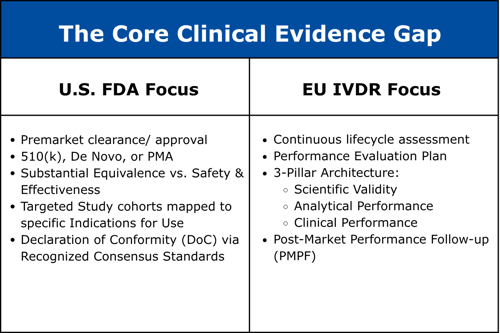
The FDA Landscape: Predicates, Risk Classification, and Least Burdensome Review
In the United States, premarket pathways are governed by risk tiering:
-
510(k) Premarket Notification: Primarily used for Class II (moderate-risk) devices to demonstrate that the new test is substantially equivalent in safety and performance to a legally marketed predicate device.
-
De Novo Classification: Serves as the pathway for novel diagnostics without a valid predicate, establishing a new Class I or II designation and creating a benchmark for future technologies.
-
Premarket Approval (PMA): The highest-risk classification (Class III), requiring independent, prospective clinical trial data, robust statistical endpoints, and rigorous pre-approval evaluations to confirm safety and effectiveness.
Under the guidance of the FDA's Center for Devices and Radiological Health (CDRH), reviewers operate under the congressional mandate to apply the "least burdensome approach." However, this approach still requires robust, defensible clinical data to substantiate every stated indication for use.
The EU IVDR Landscape: The Continuous Performance Evaluation
Across the Atlantic, the IVDR has replaced the self-certification model with intensive third-party oversight from Notified Bodies for the vast majority of assays (Classes B, C, and D). IVDR mandates that clinical evidence is not a static premarket deliverable, but an ongoing, documented lifecycle process captured within a Performance Evaluation Report (PER). The regulation explicitly structures evidence across three interconnected pillars:
-
Scientific Validity: The biological or medical plausibility linking the analyte to the clinical condition.
-
Analytical Performance: The assay’s technical capability to detect or measure the analyte correctly (e.g., precision, limit of detection, linearity, analytical specificity).
-
Clinical Performance: The assay’s ability to yield results that correlate with the target clinical condition in the intended target population (e.g., diagnostic sensitivity, specificity, positive/negative predictive values).
The friction for international manufacturers arises when clinical study protocols satisfy analytical precision but fail to capture the demographic diversity, epidemiological variation, or diagnostic cut-offs necessary to meet both FDA review standards and IVDR General Safety and Performance Requirements (GSPRs).
2. Deconstructing Clinical Validity: What Regulators Scrutinize
Demonstrating clinical validity requires proving that the diagnostic output delivers actionable, reliable clinical meaning. When evaluating clinical validity submissions, FDA reviewers and Notified Body technical specialists focus on four core vulnerabilities:
A. Clear Definition of Intended Purpose and Indications for Use
Ambiguity in intended clinical use is the leading cause of regulatory rejection. Regulators evaluate whether the assay is intended for screening, diagnosis, prognosis, monitoring, or companion diagnostic decision-making. A protocol designed for hospital-based diagnostic confirmation cannot rely on clinical data gathered from an asymptomatic screening cohort without introducing significant bias.
B. Reference Method and Diagnostic Truth Determination
To prove clinical sensitivity and specificity, the test under evaluation must be measured against an established, defensible standard of truth. If the reference standard relies on an imperfect comparative assay or subjective clinical adjudication, the statistical validity of the study collapses. Regulators evaluate whether comparative reference methods are harmonized, traceable, and scientifically justified.
C. Specimen Integrity and Preanalytical Variables
Clinical performance data is only as reliable as specimen handling allows. Discrepancies in sample matrix types (e.g., serum vs. plasma, capillary vs. venous blood), collection tube additives, transport timing, freeze-thaw cycles, and storage stability frequently invalidate multi-center study results.
D. Spectrum Bias and Cohort Representation
A study cohort consisting solely of severe, late-stage disease cases versus completely healthy controls inflates clinical sensitivity and specificity. Regulators expect testing across the complete spectrum of disease, including borderline presentations, interfering co-morbidities, and cross-reactive clinical mimics commonly encountered in routine practice.
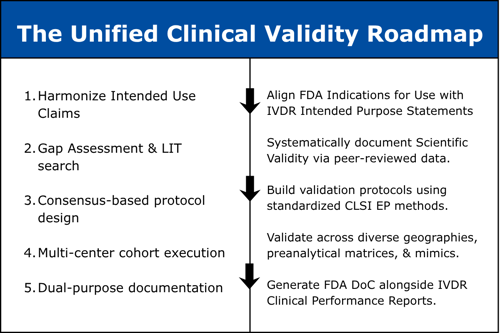
3. The 5-Step Harmonized Roadmap for Dual FDA and IVDR Compliance
To prevent running separate, costly clinical trials for each regulatory body, manufacturers can execute a unified clinical performance roadmap designed to satisfy both regulatory frameworks simultaneously.
Step 1: Establish a Unified Claim Architecture
Begin by drafting an integrated Intended Use / Intended Purpose matrix. Map every intended clinical claim, target specimen type, target population, clinical setting (e.g., central lab, point-of-care, direct-to-consumer), and clinical decision endpoint. Ensure the clinical claims align with the highest common denominator between the FDA’s Indications for Use statement and the IVDR’s Intended Purpose under GSPR Annex I.
Step 2: Conduct Systematic Scientific Validity Assessments
Compile a formal Scientific Validity Report summarizing peer-reviewed literature, clinical practice guidelines, and consensus statements that establish the biological association between the analyte and the clinical state. Documenting this foundation satisfies the first pillar of IVDR performance evaluation and provides the clinical rationale required in FDA De Novo and PMA premarket submissions.
Step 3: Design Multi-Center Study Protocols Using Consensus Standards
Clinical study design must adhere to standardized, reproducible protocols. Utilizing recognized international consensus standards, such as the CLSI Method Evaluation (EP) standards, provides an established methodological framework that regulatory authorities accept:
-
CLSI EP49 | Framework for Developing Evidence of Clinical Validity of Medical In Vitro Diagnostics: Establishes structured guidance for framing clinical utility and validity questions, selecting appropriate study designs, and mitigating common clinical study biases.
-
CLSI EP19 | A Framework for In Vitro Diagnostic Device Evaluation: Guides total assay characterization throughout the product lifecycle.
By embedding CLSI testing protocols into the clinical performance plan, manufacturers ensure their sample sizes, statistical power calculations, and acceptance criteria reflect globally vetted standards.
Step 4: Mitigate Preanalytical and Epidemiological Variables
Structure multi-site clinical trials to account for global clinical variations. Include clinical sites within the US and the EU to capture differences in standard-of-care practices, patient demographics, and regional disease prevalence. Incorporate rigorous specimen handling guidelines aligned with consensus recommendations (such as the CLSI PRE series) to eliminate preanalytical variables during collection, processing, and storage.
Step 5: Construct Dual-Purpose Technical Documentation
Translate clinical study data into modular technical documentation:
-
Structure the Clinical Performance Study Report to feed directly into the IVDR Performance Evaluation Report (PER).
-
Format statistical tables and analytical verifications to support FDA 510(k), De Novo, or PMA review packages.
-
Leverage Declarations of Conformity to accelerate FDA submission processing.
4. Accelerating Review: The Strategic Role of Declarations of Conformity
Developing clinical evidence against recognized consensus standards provides an administrative advantage during regulatory review: the ability to submit a Declaration of Conformity (DoC).
The FDA maintains a database of recognized consensus standards developed by Standards Development Organizations (SDOs) like CLSI. With more than 100 CLSI standards recognized in part or in full by the agency, manufacturers can formally declare compliance with specific standards to simplify their premarket submissions.
As Dr. Terry Woods, PhD, Director of the FDA's Division of Standards and Conformity Assessment, explains:
"All of these efforts are directed towards an overarching goal to drive the development of high-quality standards that are fit for regulatory use. A well-written standard with clear test methods and acceptance criteria makes conformity assessment more straightforward for both manufacturers and regulators."
Submitting a DoC against an FDA-recognized standard simplifies the premarket evaluation by establishing clear regulatory expectations. Rather than reviewing thousands of pages of raw, unstandardized methodological validation notes, reviewers can assess whether the study adhered to established, recognized procedures.
"Congress has directed the FDA to take the least burdensome approach to medical device pre-market evaluation," says CLSI CEO Dr. Barbara Jones. "When a standard is recognized, people who have followed that standard can point to it to be able to use it."
For EU submissions, demonstrating conformity to recognized consensus guidelines provides Notified Bodies with objective proof that test methods and clinical evaluations reflect current state-of-the-art medical practices, a key compliance requirement under IVDR Annex II and III technical documentation reviews.
5. Summary: Building Market Value Through Standardized Evidence
Navigating FDA premarket expectations and EU IVDR compliance simultaneously does not require doubling clinical validation budgets or running parallel clinical trials. The key lies in early methodological alignment. When manufacturers view clinical validity not as an isolated regional hurdle, but as a continuous, standardized scientific process, global regulatory submissions become both predictable and reproducible.
By adopting recognized consensus standards, from defining early clinical claims and standardizing method evaluation protocols to controlling preanalytical sample integrity, IVD developers can establish a single, robust evidence base. Integrating these international guidelines from the outset eliminates redundant testing, streamlines technical documentation, and empowers teams to leverage tools like Declarations of Conformity. Ultimately, building a unified clinical portfolio ensures diagnostic innovators can clear FDA review, satisfy rigorous IVDR technical assessments, and accelerate the global delivery of high-quality diagnostic technologies to the patients who need them.