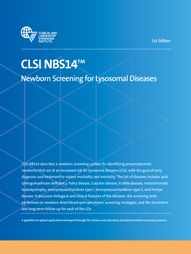
CLSI NBS14
Newborn Screening for Lysosomal Diseases
CLSI NBS14 helps newborn screening laboratories and programs identify newborns at increased risk for lysosomal diseases earlier, when timely diagnosis and treatment can make a meaningful difference.
As screening expands for these complex conditions, teams need practical guidance for integrating dried blood spot testing, multitiered assay approaches, and follow-up procedures into routine newborn screening operations.
This document provides guidance for screening eight lysosomal diseases, including:
- acid sphingomyelinase deficiency
- Fabry disease
- Gaucher disease
- Krabbe disease
- metachromatic leukodystrophy
- mucopolysaccharidosis types I and II
- Pompe disease
With recommendations covering preanalytical, analytical, and postanalytical practices, CLSI NBS14 supports more consistent laboratory operations, stronger case tracking, and clearer pathways from initial screening to diagnostic confirmation.
{{FormatPrice(currentPrice)}}
Free
{{FormatPrice(nonMemberPrice)}} List PriceCLSI NBS14—Newborn Screening for Lysosomal Diseases describes the currently available laboratory tests used to screen for 8 lysosomal diseases (LDs), which include measuring the enzyme activity for 7 LDs (acid sphingomyelinase deficiency, Fabry disease, Gaucher disease, Krabbe disease, mucopolysaccharidosis type I, mucopolysaccharidosis type II, and Pompe disease); and the concentrations of biochemical markers used in first-tier screening for metachromatic leukodystrophy. All of these LDs are inborn errors of metabolism characterized by the accumulation of substrates in excess in various organs’ cells because of the defective functioning of the lysosomes. Variants in the associated gene for each disease disorder cause the associated enzyme deficiency. Early detection of these diseases is critical for the associated therapy to be effective. For many of these diseases, there are second-tier biochemical and genetic approaches to reducing false-positive screens; these are discussed, along with an overview of the laboratory operations that detail the instrumentation, assay protocols, automated methodologies, information on validations, and implementation of routine screening.
CLSI NBS14 discusses the detection of multiple lysosomal diseases (LDs) by population-based dried blood spot (DBS) newborn screening (NBS). The list of diseases included is acid sphingomyelinase deficiency (ASMD), which is historically known as Niemann-Pick disease types A, A/B, and B; Fabry disease (FD); Gaucher disease (GD); Krabbe disease (KD); metachromatic leukodystrophy (MLD); mucopolysaccharidosis type I (MPS I); mucopolysaccharidosis type II (MPS II); and Pompe disease (PD). A liquid chromatography-tandem mass spectrometry (LC-MS/MS) assay can screen for other LDs that are not included in CLSI NBS14. CLSI NBS14 focuses on multitiered assays, which primarily start with a first-tier enzyme assay followed by a second-tier biochemical assay; this approach is used to detect all LDs except MLD. For MLD, an oppositive approach is used that includes a first-tier biochemical assay, followed by a second-tier enzyme assay. CLSI NBS14 provides information for incorporating LD DBS into the routine operations of existing NBS programs.
Also included in CLSI NBS14 is background information on the biological and clinical features of all listed LDs, detailed descriptions of the different first-tier enzyme activity assays currently in use, and the preanalytical, analytical, and the postanalytical laboratory practices used in screening for these diseases. Finally, a discussion of short- and long-term follow-up (STFU and LTFU) procedures, including case tracking, as well as the diagnostic tests needed to confirm a diagnosis for each of the diseases is included.
This document is available in electronic format only.
CLSI NBS14—Newborn Screening for Lysosomal Diseases describes the currently available laboratory tests used to screen for 8 lysosomal diseases (LDs), which include measuring the enzyme activity for 7 LDs (acid sphingomyelinase deficiency, Fabry disease, Gaucher disease, Krabbe disease, mucopolysaccharidosis type I, mucopolysaccharidosis type II, and Pompe disease); and the concentrations of biochemical markers used in first-tier screening for metachromatic leukodystrophy. All of these LDs are inborn errors of metabolism characterized by the accumulation of substrates in excess in various organs’ cells because of the defective functioning of the lysosomes. Variants in the associated gene for each disease disorder cause the associated enzyme deficiency. Early detection of these diseases is critical for the associated therapy to be effective. For many of these diseases, there are second-tier biochemical and genetic approaches to reducing false-positive screens; these are discussed, along with an overview of the laboratory operations that detail the instrumentation, assay protocols, automated methodologies, information on validations, and implementation of routine screening.
CLSI NBS14 discusses the detection of multiple lysosomal diseases (LDs) by population-based dried blood spot (DBS) newborn screening (NBS). The list of diseases included is acid sphingomyelinase deficiency (ASMD), which is historically known as Niemann-Pick disease types A, A/B, and B; Fabry disease (FD); Gaucher disease (GD); Krabbe disease (KD); metachromatic leukodystrophy (MLD); mucopolysaccharidosis type I (MPS I); mucopolysaccharidosis type II (MPS II); and Pompe disease (PD). A liquid chromatography-tandem mass spectrometry (LC-MS/MS) assay can screen for other LDs that are not included in CLSI NBS14. CLSI NBS14 focuses on multitiered assays, which primarily start with a first-tier enzyme assay followed by a second-tier biochemical assay; this approach is used to detect all LDs except MLD. For MLD, an oppositive approach is used that includes a first-tier biochemical assay, followed by a second-tier enzyme assay. CLSI NBS14 provides information for incorporating LD DBS into the routine operations of existing NBS programs.
Also included in CLSI NBS14 is background information on the biological and clinical features of all listed LDs, detailed descriptions of the different first-tier enzyme activity assays currently in use, and the preanalytical, analytical, and the postanalytical laboratory practices used in screening for these diseases. Finally, a discussion of short- and long-term follow-up (STFU and LTFU) procedures, including case tracking, as well as the diagnostic tests needed to confirm a diagnosis for each of the diseases is included.
This document is available in electronic format only.