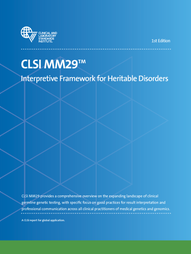
CLSI MM29
Interpretive Framework for Heritable Disorders
CLSI MM29 provides a comprehensive overview on the expanding landscape of clinical germline genetic testing, with specific focus on good practices for result interpretation and professional communication across all clinical practitioners of medical genetics and genomics.
{{FormatPrice(currentPrice)}}
Free
{{FormatPrice(nonMemberPrice)}} List PriceCLSI MM29—Interpretive Framework for Heritable Disorders provides a structured overview on professional communication between laboratorians and clinical providers in the context of constitutional genetic and genomic testing. It is intended to facilitate more informed and effective test interpretation and clinical decision-making by medical genetics practitioners, including laboratory directors, genetic counselors, clinicians, regulatory and commercial partners, and other health care professionals. CLSI MM29 focuses on distilling the complexity of constitutional/germline genetic testing for heritable diseases with emphasis on shared understanding and professional communication, with the overarching goal of improving clinical care and patient experiences. Clinical genetic and genomic testing is an evolving area, in large part due to the rapid advances in molecular technologies that enable more accessible and comprehensive health information, which necessitates ongoing evaluation of appropriate use and good practices among health care stakeholders.
Fundamental concepts in clinical molecular and cytogenomic testing are detailed, including both diagnostic testing and predictive screening, all presented in the context of result interpretation and appropriate counseling among professionals and patients. To facilitate an effective and structured overview, separate subchapters are devoted to the following areas: medical genetic practitioners, basic genetic testing principles, spectrum of genetic/genomic technologies, and integrating genetic results into clinical care decisions.
CLSI MM29 emphasizes the essential role of the laboratory director and/or applicable personnel to engage effectively with medical care personnel to accurately describe and convey the appropriate clinical indications for pursuing genetic testing for heritable conditions. Laboratory directors can actively create opportunities for shared decision-making with clinician colleagues to help integrate evolving technologies into clinical decisions for patient care.
CLSI MM29 also focuses on the accurate interpretation(s) of genetic test results to include the implications for patients and their relatives when relevant. Limitations of genetic testing, such as gene and/or variant content included in the analyses, are also described.
CLSI MM29 does not include detailed descriptions of genetic testing methodologies (covered in CLSI MM01), a catalog of genetic disorders, or how to establish a molecular genetic testing laboratory (covered in CLSI MM19). CLSI MM29 does not cover directing or growing a laboratory, assay development/validation, or quality management (covered in CLSI MM26).
Because there are genetic laboratories in various settings (eg, commercial or academic reference laboratories, commercial specialty genetic laboratories, and genetic laboratories within academic medical centers or hospitals), information provided in CLSI MM29 should be applied by laboratorians as appropriate based on institutional context and professional judgement.
This document is available in electronic format only.
CLSI MM29—Interpretive Framework for Heritable Disorders provides a structured overview on professional communication between laboratorians and clinical providers in the context of constitutional genetic and genomic testing. It is intended to facilitate more informed and effective test interpretation and clinical decision-making by medical genetics practitioners, including laboratory directors, genetic counselors, clinicians, regulatory and commercial partners, and other health care professionals. CLSI MM29 focuses on distilling the complexity of constitutional/germline genetic testing for heritable diseases with emphasis on shared understanding and professional communication, with the overarching goal of improving clinical care and patient experiences. Clinical genetic and genomic testing is an evolving area, in large part due to the rapid advances in molecular technologies that enable more accessible and comprehensive health information, which necessitates ongoing evaluation of appropriate use and good practices among health care stakeholders.
Fundamental concepts in clinical molecular and cytogenomic testing are detailed, including both diagnostic testing and predictive screening, all presented in the context of result interpretation and appropriate counseling among professionals and patients. To facilitate an effective and structured overview, separate subchapters are devoted to the following areas: medical genetic practitioners, basic genetic testing principles, spectrum of genetic/genomic technologies, and integrating genetic results into clinical care decisions.
CLSI MM29 emphasizes the essential role of the laboratory director and/or applicable personnel to engage effectively with medical care personnel to accurately describe and convey the appropriate clinical indications for pursuing genetic testing for heritable conditions. Laboratory directors can actively create opportunities for shared decision-making with clinician colleagues to help integrate evolving technologies into clinical decisions for patient care.
CLSI MM29 also focuses on the accurate interpretation(s) of genetic test results to include the implications for patients and their relatives when relevant. Limitations of genetic testing, such as gene and/or variant content included in the analyses, are also described.
CLSI MM29 does not include detailed descriptions of genetic testing methodologies (covered in CLSI MM01), a catalog of genetic disorders, or how to establish a molecular genetic testing laboratory (covered in CLSI MM19). CLSI MM29 does not cover directing or growing a laboratory, assay development/validation, or quality management (covered in CLSI MM26).
Because there are genetic laboratories in various settings (eg, commercial or academic reference laboratories, commercial specialty genetic laboratories, and genetic laboratories within academic medical centers or hospitals), information provided in CLSI MM29 should be applied by laboratorians as appropriate based on institutional context and professional judgement.
This document is available in electronic format only.